
How Chino Residents Are Found
There is no single Chino roll that lists every person who lives in the city. Start with the strongest fact in hand. A Chino residents directory search may lead to a court party search, a business filing, a professional license, or a recorded deed. An address is better handled through the Chino Land Use Viewer and the San Bernardino County Parcel Access map. A family-history question may begin with a city directory, census schedule, newspaper notice, or probate case instead of a current index.
The result must be labeled accurately. A parcel association can indicate an owner or assessed connection, but it does not prove occupancy. A voter record is controlled by California law and is not a casual street list. A directory entry reflects the publisher's selection and publication date. These limits make a small, dated research log more useful than one unverified match.
- Write down the exact name, address, spelling, date, and reason for the search.
- Use Chino's map and the county parcel tool to identify the APN when an address is known.
- Move from the APN or name to the recorder, court, vital, business, or license index that fits the question.
- Compare dates, roles, places, and related names in at least two independent records.
- Use a counter visit, mail order, library, archive, or CPRA request when the online result stops.
Note: A negative online result may reflect a coverage boundary, spelling variation, sealed record, or identity gate rather than absence.
Chino's Resident Records Offices
Chino records split among the city, San Bernardino County, and California agencies. The San Bernardino County Assessor-Recorder-Clerk handles deeds, assessment clues, county vital certificates, marriage licenses, fictitious business names, and related recorded instruments. The Superior Court keeps case records. City Hall handles permits, planning files, council material, and public-record requests. State systems add voter status, professional licenses, business filings, corrections, and confidentiality programs.
San Bernardino County ARC
222 W. Hospitality Lane, First Floor
San Bernardino, CA 92415
909-387-8306
San Bernardino County Assessor
Parcel and assessment information
Countywide Chino coverage
909-387-8307
San Bernardino County Elections
777 E. Rialto Avenue
San Bernardino, CA 92415-0770
909-387-8300
For city material, Chino City Clerk requests go through NextRequest, by the City Hall counter, or through the clerk's published contact route. Building and Planning matters run through the city's Development Services channels. Each office can explain its own access rule, but none is a complete residents directory.
Chino Address Records to APN
The cleanest local bridge is address to APN to named party. In the Chino Land Use Viewer, use the magnifying-glass search for an address or APN, inspect the parcel, switch between street and aerial basemaps, and save the date of the map view. The viewer supports sharing, PDF printing, and help controls. It supplies land-use geography, not a title opinion.
Check the same parcel in County Parcel Access. A parcel card can show the APN, situs, geometry, characteristics, valuation years, exemption indicators, transfer datasets, and a parcel-map link when public. The county warns that assessment data establish an assessment relationship, not legal title or permitted use. An APN is an index key. A deed's legal description, tract, lot, block, and recording language carry the stronger evidence.
| Address or APN | Single text search in the Chino viewer; the address is the starting key. |
|---|---|
| Map controls | Street or aerial basemap, map click, share, print PDF, and help. |
| Parcel result | APN, situs, parcel geometry, characteristics, valuation context, and map linkage. |
| Next handoff | Use the APN and verified name clues to search recorder grantor and grantee fields. |
- Parcel
- A mapped unit used for assessment; it may change after a split, merger, or tract revision.
- Situs
- The physical property location, distinct from a mailing address used for notices.
- Index
- A finding aid that points to a record; it is not the same as the record image or certified copy.
- Roll
- A keeper's organized list, such as an assessment roll or voter file, with its own access limits.
The county parcel source captured for the Chino address workflow is linked through County Parcel Access.
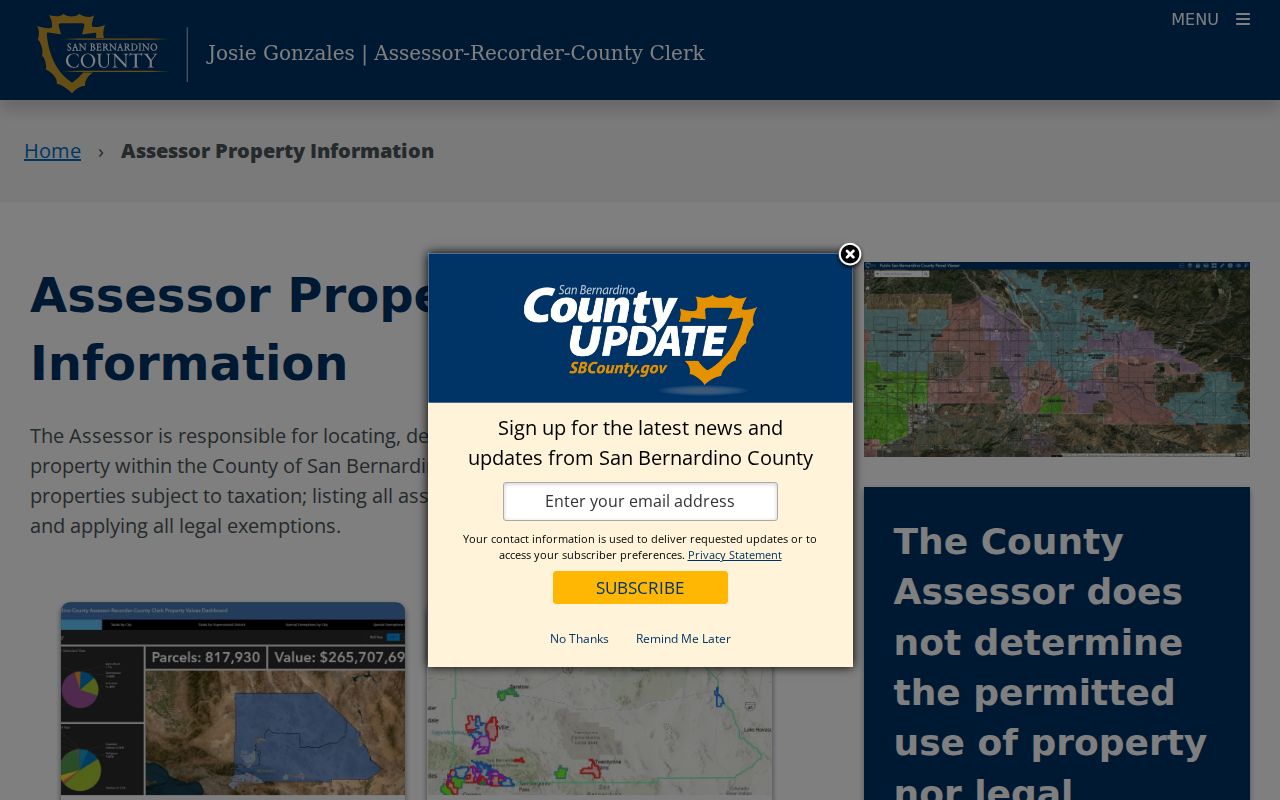
The parcel view supplies the modern APN layer before a name or legal description is tested in another record.
Current Chino Resident Sources
Different directory-like sources answer different questions. A county assessment result can connect a parcel with value and assessment information. A recorder index can identify a grantor or grantee. A court docket can show a party role and case chronology. A business or professional-license search can confirm a public affiliation. The state voter-status tool answers the requester's own status and does not browse other residents by name.
| Source | Useful clue | Keeper | Access |
|---|---|---|---|
| Parcel Access | APN, situs, assessment context | County Assessor | Free map; personal fields restricted |
| Official Records Index | Deed parties, dates, document types | County Recorder | Free metadata from 1925-present |
| Court Access Portal | Case party, type, status, filing trail | San Bernardino Superior Court | Online metadata; clerk for files |
| Business and license searches | Entity, agent, license status, public address | California agencies | Free search; certification varies |
| City records | Permits, applicants, planning and civic filings | City of Chino | Portal or CPRA request |
A practical lookup starts with the record closest to the question, then uses a second keeper for confirmation. The Chino resident lookup workflow is useful when one name needs a careful match. Records that identify a business contact or official can help reconnect with a person, but they should not be turned into a claim about a private household.
The California business search source captured for the current-records comparison is linked through bizfile.
An entity filing is a public affiliation clue with its own date and field limits.
Chino Recorder Records and Parties
The San Bernardino County Official Records Index covers 1925 to the present. Its documented fields are document number, recording date or date range, document title or type, grantor, and grantee. Grantor means the party transferring or granting an interest. Grantee means the receiving party. The index can show a named transaction trail, but it does not search ownership by street address.
Use a name, date, document type, and spelling variations. A result may show document number, document date, recording date, title, grantors, and grantees. It is a catalog-style finding aid, not the image. The public web index does not display ordinary document images. A non-certified image can be ordered for email, while a certified order ships. Mail a completed copy form and payment to 222 W. Hospitality Lane, First Floor, San Bernardino, and expect normal mail returns in one to two weeks according to the county.
The public counter route is another channel. Appointments are strongly encouraged at the Hall of Records, and the High Desert Government Center in Hesperia is a second counter. Phone ARC when the correct office or form is unclear. For a Chino address, derive the party name from the parcel and other records first, then use the party index rather than treating the street as a recorder search field.
The official recorder source captured for this party-index route is the San Bernardino County Official Records Index.
The recorder view reinforces that an address clue must become a party or document search before an image can be ordered.
Note: The 1925 online start date is a web-index boundary, not evidence that older Chino deeds were never recorded.
Chino Court Lookup With Care
The San Bernardino Superior Court Court Access Portal, known as CAP, is the right starting point for county trial cases. It supports case number and party or name searches, with additional filters that may include filing date, party type, case category, case type, status, judge, and court location. A basic case number is five to sixteen alphanumeric characters. Party first and last names have minimum character rules when those fields are enabled, and a date of birth uses month, day, and year.
| Party result | View case, case number, party name, court location, case status, case type, and filing date. |
|---|---|
| Case detail | Parties, attorneys, hearings, events, documents, disposition or status, and category-specific fields. |
| Older data | Limited criminal and traffic data exist online for cases filed before 1998. |
| Access fallback | Contact the filing district clerk or use the court copy process for a file or certification. |
CAP is a same-name trap unless the dates and roles line up. Try middle initials, punctuation, hyphenation, and spelling variants. The court guide's probate example shows tabs for case information, parties, events, hearings, documents, and financials, but not every field is public in every category. Federal matters belong in the federal court system, not the county portal.
The public CAP source captured for the Chino court workflow is linked through San Bernardino Superior Court.
A case portal result still needs date, role, and filing-district checks before it becomes a person match.
Chino Voter Records Stay Controlled
California My Voter Status authenticates the person making the request. It asks for identifying information such as name, birth date, California identification details or the last four Social Security number digits as the interface directs, plus county. It returns the requester's status and election information. It is not a public Chino surname index and it cannot be used to browse a block.
Government Code §7924.000 protects home address, phone, email, precinct identifiers, prior registration, identification numbers, Social Security numbers, and signatures. Elections Code §2194 permits voter-file access only for election, scholarly, journalistic, political, or governmental purposes. San Bernardino County requires an application, identity verification, an intended-use statement, and an original wet signature for a voter file. Approved products can be delivered by email or thumb drive, and the county's current application lists scope filters, history options, and separate fees.
For a Chino resident search, use the status tool only for the requester's own record. Treat any authorized file as a regulated dataset, not a general directory. The county elections office can explain its application and current price sheet. A weekly report of registration provides aggregate counts, not a list of individuals.
The identity-gated voter source captured for this section is linked through California My Voter Status.
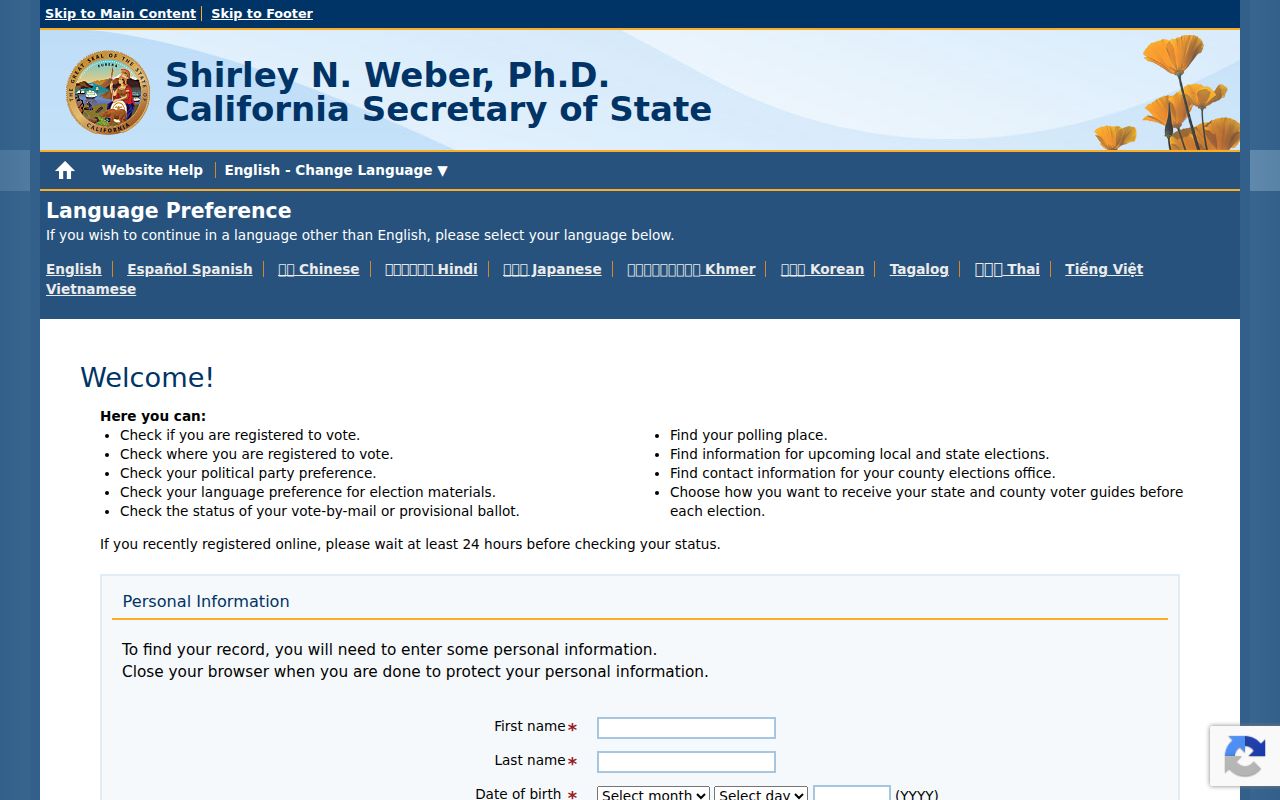
The form shows why a personal status result is different from a public street or surname index.
Chino Vital Records and Certificates
Birth, death, marriage, and divorce material is not one open name index. San Bernardino County ARC issues county certificates and licenses, while the California Department of Public Health Vital Records office maintains statewide services. Birth and death certificates use authorized and informational copy rules. An authorized copy is limited to people in Health and Safety Code §§103526 and 103526.5. An informational copy is marked not valid to establish identity. Confidential marriages have a separate rule under Family Code §509, and adoption records are sealed.
| Record | Custodian | Access distinction |
|---|---|---|
| Birth | County ARC or CDPH | Authorized or informational copy; adoption files sealed |
| Death | County ARC or CDPH | Authorized copy rules and restricted sensitive portions |
| Marriage | County clerk or CDPH | Public marriage differs from confidential marriage |
| Divorce | Superior Court and CDPH | Certificate or abstract is distinct from the court decree |
As of the research dated for this build, CDPH fees are $31 birth, $26 death, $19 marriage, and $18 dissolution. County fees differ: $34 birth, $26 death, and $19 marriage. Use the official application, relationship category, sworn statement, and notary instructions. A no-record search can produce a Certificate of No Public Record without returning the search fee. Newspapers, cemetery records, probate, and church registers are finding aids, not substitutes for a certified certificate.
Chino Public Records Requests
When an existing city record is not online, the Chino public-records request portal is the documented fallback. A useful request names the address or APN, department, date range, record type, and a narrow description. Ask for an existing permit, report, agenda item, contract, email set, or code record. The California Public Records Act, recodified at Government Code §§7920.000-7931.000, does not require staff to create a new list or answer interrogatories.
Chino says requests received after 5:30 p.m., on a weekend, or on a holiday arrive on the next regular business day. The regular City Hall hours listed by the city are Monday through Friday, 7:30 a.m. to 5:30 p.m. Staff generally make a ten-calendar-day determination, with a written extension of up to fourteen days in unusual circumstances. Inspection is ordinarily free; authorized copy costs may apply.
Development Services uses Accela for planning and building permits, and the city publishes applications, an address request form, site-plan examples, and a dated fee schedule. Online visibility varies by module. The city reports that a public-record request can obtain copies of building permits, while project plans may be viewed in person and online access can be limited to owners, contractors, and designers with accounts. Code-enforcement complaints also have privacy and active-investigation limits.
Note: A precise date range and APN gives Chino staff a workable records request without asking the city to assemble a new residents list.
Chino's Historical Directory Shelf
Chino appears in regional Pomona-centered city directories rather than only in a stand-alone Chino title. The Gale/Cengage microfilm guide verifies Chino-bearing reels for 1909/10-1912/13, usable 1914 and 1919/20 issues, 1926-1928 with 1927 missing, 1931-1934 with 1932 and 1933 missing, 1937/38-1940 with 1939 missing, and 1951. Do not turn the gaps into a smooth annual run.
The Chino city directory collections page is the place for the complete shelf and entry-reading treatment. The short version is that a historical entry may name a person, spouse, occupation, employer, residence marker, and street address. Reverse or criss-cross sections, when present, sort by street and number. The Chino Branch library, Feldheym California Room, Ontario local-history resources, and county archives are the practical channels when a scan or catalog record does not answer the question.
Chino Historical Records Map Bridge
The Library of Congress preserves a free four-sheet Chino Sanborn fire-insurance map from February 1895. The map does not name residents, but it can anchor an old street name, building footprint, use, and number before a directory or deed is read. Federal Historic American Engineering Record material also cites Chino key sheets for 1897, 1907, 1912, 1925, and 1932. Those later years are a research lead, while the 1895 gallery is the directly verified online source.
Compare the map with the directory address, census household, and legal description. Agricultural parcels and later planned communities can use different keys. The map is a bridge between place and person, not proof that a named household occupied a particular building.
The map source is the Library of Congress Chino Sanborn gallery. The directly verified image is a public-domain historical map, while the current parcel layer belongs in the address workflow above.
Finding a Chino Heir Through Records
Probate, deeds, and obituaries can form a lawful family-history chain. Start with a verified person or address, then use CAP to locate a probate case when one exists. A case can show decedent, petitioner, heirs, counsel, hearings, documents, and financial tabs, although public fields vary and addresses may be redacted. The probate guide's notes explain that hearing notes appear on a limited time window around the hearing.
Pair a probate result with the recorder's named-party index. A deed recorded after a petition may show a transfer, but the date and legal description matter. An obituary can add relatives and a last community, while the certified court file or certificate remains the stronger source for the legal event. The approach works for reconnecting relatives and estate research without claiming that a public clue proves a current residence.
For a birth-parent question, California adoption records are sealed and the proper route is an authorized state adoption service, not an attempt to bypass confidentiality. For an old address, use directories and census schedules to establish household context, then let probate and deeds explain an ownership transition.
Where Chino Records Stop Online
Online coverage has clear edges. The recorder web index begins in 1925 and does not show ordinary images. Assessment valuations begin in 1978, with statutory restrictions on bulk owner and address fields. San Bernardino criminal and traffic data are limited for cases filed before 1998. Regional directory runs have missing years. The 1890 federal census is largely destroyed nationally. A careful search records which edge caused the gap.
| Official source | Online convenience | Documented fallback |
|---|---|---|
| Recorder | 1925-present index metadata | Email or mail copy order; Hall of Records or Hesperia counter; archives for earlier material |
| Assessor | Interactive parcel map and 1978-present valuation context | Phone or counter help; recorder for title evidence |
| Court | CAP party and case metadata | Filing district clerk, copy form, in-person file viewing |
| Historical sources | LOC map, selected scans, Census access | Chino Branch, Feldheym California Room, Ontario history room, archives |
Official rolls and commercial data compilations are not equivalent. An official index has a named custodian, a defined field set, and a correction path. A compilation may be fast but can lag, merge similar names, or charge for uncertain details. The safer practice is to use a compilation only as a lead and return to the originating county, court, city, state, library, or archive.
Chino Lookup Privacy and Wrong Matches
California's Safe at Home Address Confidentiality Program gives eligible survivors and other protected participants a substitute mailing address, mail forwarding, a service-of-process agent, and confidential voter registration. It does not erase old public records. Government agencies and courts must accept the substitute address subject to the governing statutes, and participants may request substitute-address use on deeds and related property forms under Government Code §§6207 and 6209.5.
A wrong match should be corrected at the source. Keep the query date, record number, spelling, middle initial, APN, case type, and competing facts. Ask the custodian about its correction or redaction process. The California Consumer Privacy Act and Delete Act can provide rights against qualifying businesses or data brokers, but the DROP portal does not delete county, court, or state source records.
Note: Preserve the custodian's wording and date because indexes, fees, portal fields, and privacy rules can change.