
Finding Chino Households by Street
A street-first search works as a sequence of keys. The city viewer is the visual starting point. The county assessor supplies assessment context and an APN. The recorder index accepts parties and document clues, not a casual street browse. City permits add project history. A voter file is controlled and cannot be used as a public list of nearby names. A reverse directory, if a library confirms that it holds one, can add a historical occupant for a publication year.
Keep a separate line for each source. Record the query date, contemporary address, APN, legal description, indexed party or applicant, and confidence. An assessed owner is not automatically the person living there. A permit applicant is not automatically the occupant. A directory entry is not a current address. These distinctions keep a Chino address trail useful for property history, civic research, and reconnecting without overstating what a record says.
- Enter the Chino street address or APN in the city Land Use Viewer and inspect the mapped parcel.
- Switch between street and aerial basemaps, note the surrounding streets, and print or save the map extent.
- Check County Parcel Access for APN, situs, characteristics, valuation context, and parcel-map linkage.
- Use the resulting name and APN clues in the recorder's grantor and grantee fields.
- Compare a permit, court, directory, or other independent record before calling a name a match.
Chino Records Searchable by Street
Not every record set is keyed the same way. The table below separates the address-facing source from the evidence it can actually supply. This is the practical core of a Chino address record trail: it shows where a street clue can lead and where the next custodian must take over.
| Record set | Keeper | Street-facing result | Limit or access |
|---|---|---|---|
| Land Use Viewer | Chino Development Services | Parcel location, land-use designation, surrounding streets | Free map; not ownership proof |
| Parcel Access | San Bernardino County Assessor | APN, situs, characteristics, assessment geography | Bulk personal fields restricted |
| Recorder index | San Bernardino County ARC | Named grantor, grantee, document date and type | 1925-present; no street-address ownership search |
| Accela permits | Chino Building and Planning | Project address, applicant, contractor, status, inspections | Module visibility varies; CPRA fallback |
| Reverse directory | Library or archive if held | Listed occupant or business by street and number | Chino run and section coverage unverified |
A current street question usually needs the viewer, parcel map, and recorder together. A past-occupant question belongs with a city directory, census, newspaper, or archive. The full street directory chain stops short of an all-household roster because the public sources themselves do.
Search Chino Streets on the Land Use Viewer
The Chino Land Use Viewer documents a focused address and parcel workflow. Select the magnifying glass, enter an address or APN, inspect the map, choose a basemap, and use share or print when a dated research note is needed. Street and aerial views can help distinguish a parcel in an older core from a planned tract. The viewer can show land-use or specific-plan geography, but planning information must be verified with the city.
| Address or APN | Single search box; use the known address first, then preserve the returned APN. |
|---|---|
| Map action | Magnifying-glass Search and map click for the parcel and its neighbors. |
| Basemap | Street-name and aerial choices help compare the parcel with the visible block. |
| Share | Email, Facebook, or Twitter controls are documented on the city map page. |
| Landscape or portrait PDF can preserve the map extent used in the search. |
Save the date, address or APN entered, basemap used, and parcels inspected. A map view is a reproducible location clue. It is not a title report, a current-resident statement, or a substitute for the county recorder.
The county office image is linked through the San Bernardino County Assessor-Recorder-Clerk home page.
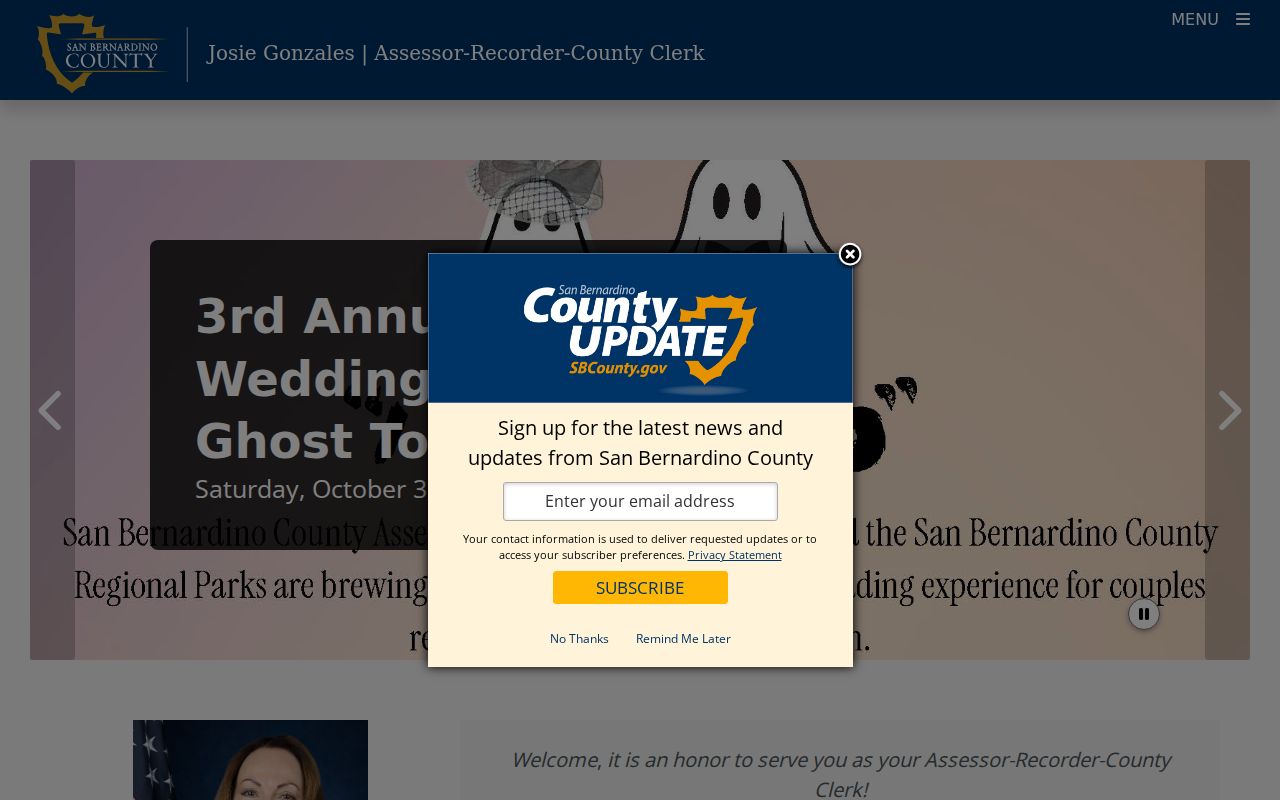
The county office page supplies the administrative handoff after the city map has produced an APN or location clue.
Turn a Chino Address Into a Deed Search
The San Bernardino recorder expressly warns that the official index does not locate ownership by street address. That is why the street directory workflow derives a party name or APN clue before opening the Recorder self-service gateway. Search document number, recording date or date range, title or type, grantor, and grantee. Try spelling variations and do not assume the first same-name result belongs to the mapped parcel.
A result supplies catalog fields such as document number, document date, recording date, title, grantors, and grantees. The ordinary web result is not the image. The public index covers 1925-present and images are obtained by order or at a counter. A non-certified order can be emailed. A certified order ships. Mail requests use the county form, a check or money order, and the Hospitality Lane address; normal mail return is described as one to two weeks.
The correct chain is address to APN, APN to name clue, name to party index, party result to document image, and image to legal description. A deed's legal description may use tract, lot, block, or a subdivision map rather than the street number. The deed parties establish a recorded transaction. They do not, by themselves, establish who occupied the property.
One county screenshot is available from the official recorder search gateway.
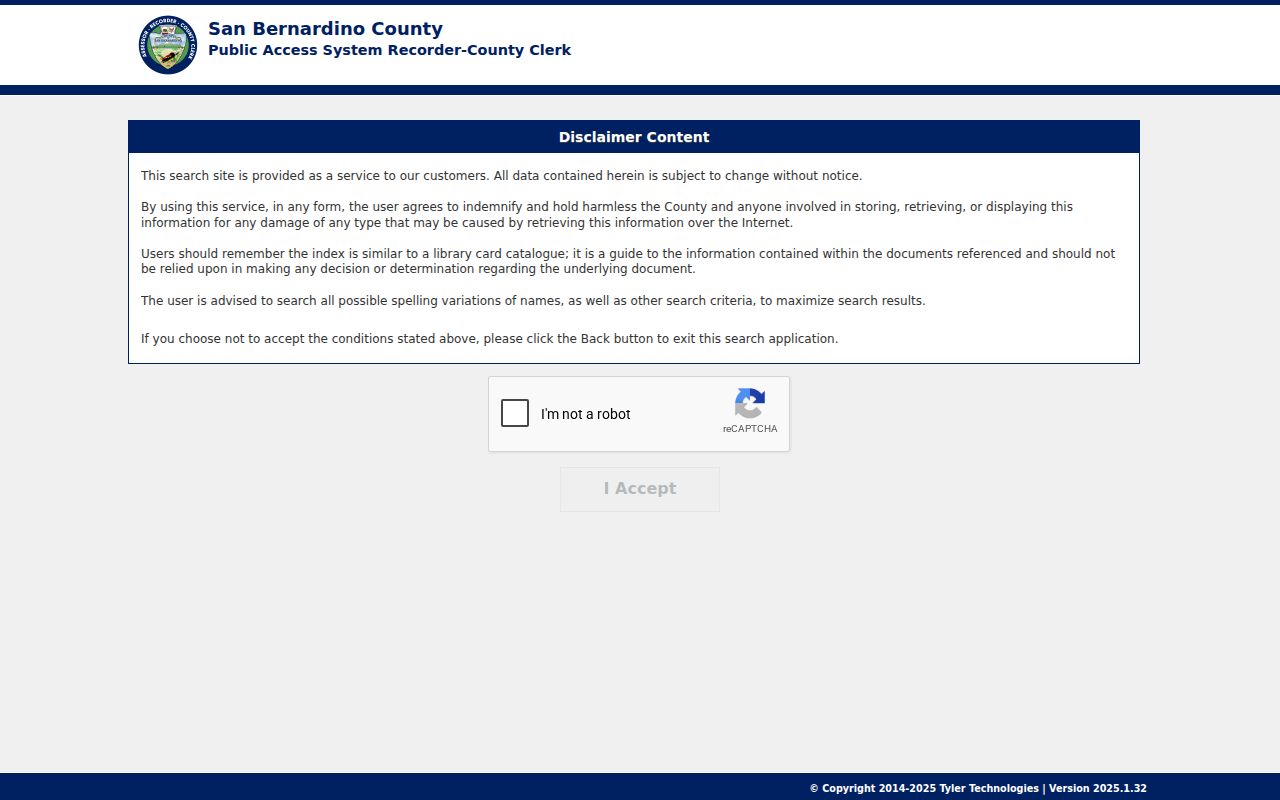
The self-service view reinforces the difference between a party-index query and an address-based map query.
Note: The county describes the index like a library card catalog, so every spelling and date clue matters.
Situs, Mailing Address, and Legal Description
Three address terms can look alike in a search result but carry different meanings. Situs is the physical place assessed by the county. A mailing address is where notices or tax bills go. A legal description identifies land through a tract, lot, block, map, metes-and-bounds description, or related instrument. A street number can change while the legal description remains the better bridge.
- APN
- The assessor's parcel number, useful for map and assessment indexing but not a permanent title conclusion.
- Situs address
- The physical location of the parcel; it may differ from the mailing address.
- Legal description
- The formal land description in the recorded instrument, often more durable than a street label.
- Plat
- A recorded map that lays out lots, blocks, streets, easements, or subdivision geometry.
- Criss-cross directory
- A reverse directory arranged by street and number, useful for a publication year's listed occupant.
These distinctions matter in Chino's agricultural north, older central neighborhoods, and newer southeastern planned communities. A split parcel, tract change, or new address can break a naive street search. Keep the APN, lot or tract, old number, current number, and map source in separate fields.
Chino Permit History by Address
Building and planning records add a project layer to a street directory. Chino Development Services uses Accela Citizen Access, and the research captured address, parcel, record number, license, date, and status modes as varying by module. A public result may identify project address, permit type, applicant, contractor, issue or status information, and inspections. The city itself cautions that online visibility is not the same as the participant's account access.
Use the city's Accela portal for the available search, then use the building applications and forms page for the published form and fee context. If an older permit is not visible, request the existing record through Chino NextRequest. The city reports that permit copies can be obtained after a public-record request. Project plans may be viewed in person, while owners, contractors, and designers can have different online access after account creation.
The image below comes from the Chino Accela portal captured for this street-records topic.
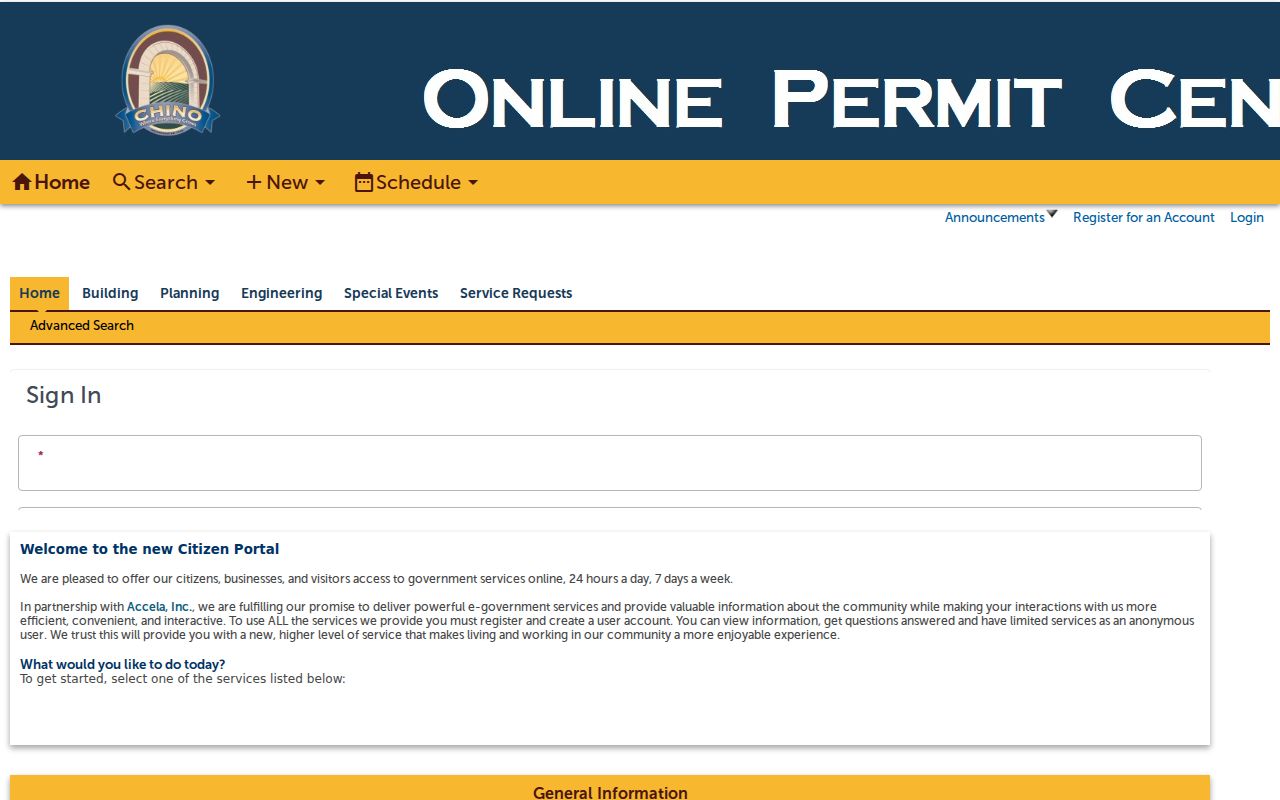
A permit dates a project or inspection. It does not date a resident's move and does not establish that the applicant lived at the address.
Adjacent Parcels Along a Chino Street
When the question expands from one address to a whole street, use the viewer to click mapped parcels one at a time. Inspect the polygons, record adjacent APNs, and repeat the parcel-context check. The city page documents search, basemap, share, print, and help controls. It does not document a radius or buffer function, so a street directory should not promise one.
County assessment context can help compare parcel size, characteristics, valuation years, and tax districts. A neighboring APN is a geography clue, not a name list. The full adjacent-parcel method belongs to the Chino neighbors lookup when the goal is the immediate block. The street directory stays focused on the named street and its record chain.
| Map click | Identify each polygon and APN visible around the subject address. |
|---|---|
| Assessment check | Compare parcel description, characteristics, and value context. |
| Record handoff | Use party clues for the recorder or project clues for permits. |
| Boundary caution | Do not treat the assessed owner, mailing contact, or map label as every occupant. |
The Chino Recorder's 1925 Edge
The web recorder index reaches 1925-present, while San Bernardino County historical archives describe county record series that reach much earlier. For a street with an older agricultural or town history, the absence of a web hit can simply mean the deed sits in books, microfilm, or an archival finding aid. The county's historical archive route covers records before the modern portal, and the archive page describes county records beginning with formation in 1853.
The County Historical Archives research room is at 412 W. Hospitality Lane in San Bernardino, with the published phone 909-387-1001 and posted morning and afternoon hours. The archive catalog, rather than the ordinary recorder portal, is the route for older material. Libraries and the Chino Branch can help with directories and newspapers. Start with the current map, a legal description, and a likely party name so an archivist has a useful search frame.
That numerical boundary is one of the central facts in a Chino street directory. It separates a free online metadata route from an offline records route, not a real beginning of Chino land history.
Historic Chino Streets on Sanborn Maps
The Library of Congress four-sheet Sanborn set from February 1895 can help identify how a street, building footprint, and use were arranged before later subdivisions. Federal documentation cites Chino key sheets in 1895, 1897, 1907, 1912, 1925, and 1932. Only the 1895 gallery was directly verified in the research, so later years are an acquisition lead rather than a promise of an online scan.
Compare a historical number with a directory entry, census household, and deed description. A map can show a building without naming the person inside it. An old street label may also predate a later subdivision or address change. Use it to test continuity, not to fill a missing resident name.
The directly verified map source is the Library of Congress Chino gallery.
The county tax-search image below is linked through the San Bernardino County Tax Collector.
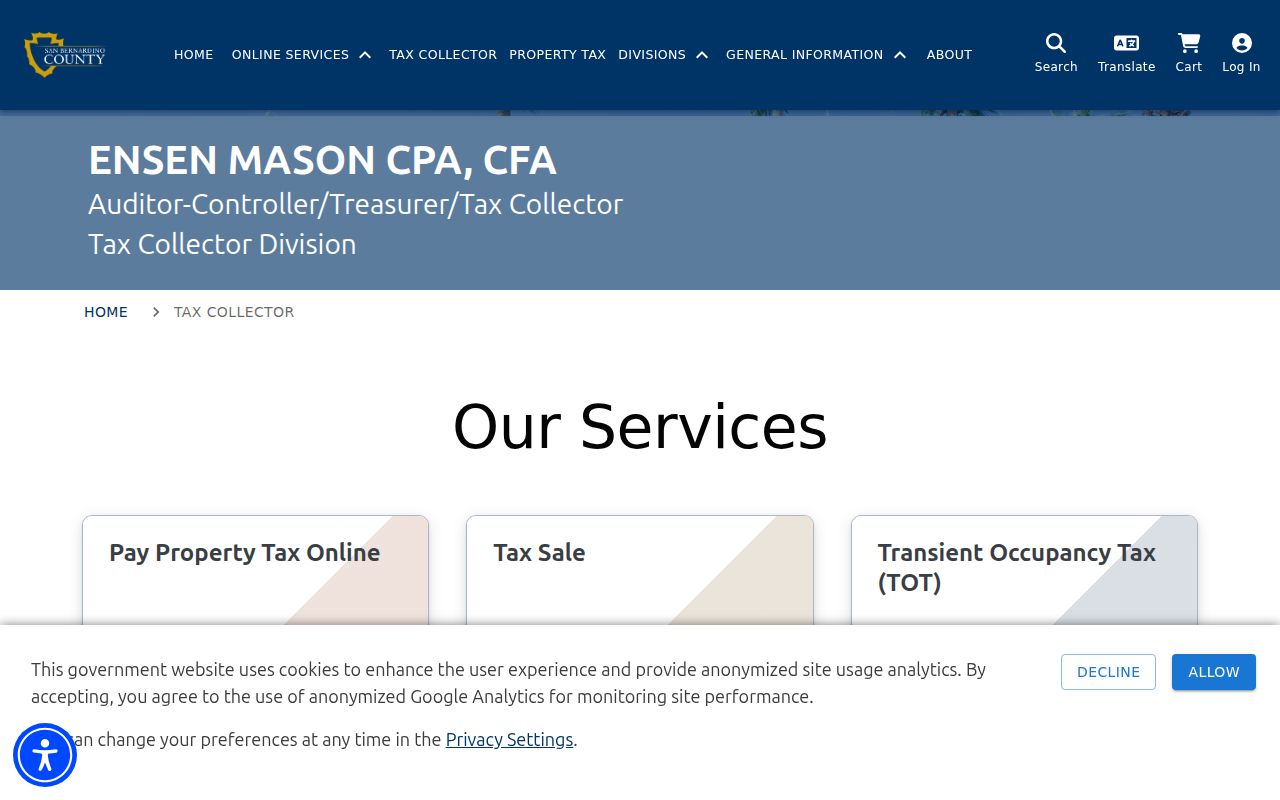
The tax-search view can connect an APN to billing history, but payment information is not proof that a person occupied the street address.
What a Chino Reverse Directory Adds
A reverse or criss-cross directory sorts by street and house number instead of surname. When a Chino-bearing regional volume has that section, it can bridge an address to a listed occupant or business for a publication year. The entry may include surname, given name or initial, spouse notation, occupation, employer, residence marker, and abbreviated street address. It is a historical listing, not a live resident file.
The research verifies regional Pomona reels carrying Chino for selected years from 1909/10 through 1951, with several missing issues. It does not locate an official online shelf inventory that proves every reverse-section run, publisher, or exact Chino page range. Contact the Chino Branch at 13180 Central Avenue, 909-465-5280, or the Feldheym California Room before claiming that a particular year is on the shelf. Ontario City Library is another regional lead.
For the collections themselves and sample entry marks, use the Chino city directory collections treatment rather than rebuilding the historical shelf here. The street angle only needs the reverse section's address key and its publication-date limit.
Why Chino Voter Data Is Not a Street List
California My Voter Status is identity-gated and returns the requester's own status. It is not a public Chino street directory. San Bernardino County voter-file products require an application, verified identity, permitted purpose, and signed agreement. Elections Code §2194 limits access to election, scholarly, journalistic, political, or governmental purposes. Government Code §7924.000 keeps home addresses, phone numbers, emails, identifiers, and signatures confidential except through that controlled regime.
A street search should not try to enumerate nearby voters. The county's weekly report supplies aggregate registration counts, while a lawful file request may have geographic scope only when the applicant qualifies. Safe at Home participants can use confidential registration and a substitute address. These rules protect people who would otherwise be exposed by a simplistic name-to-street list.
What the Chino Street Directory Cannot Show
Public parcel and deed sources do not list every person present at an address. Renters, relatives, visitors, and unlisted household members may not appear. DMV data are restricted by the federal Driver's Privacy Protection Act. Utility customer lists are not public resident directories. A mailing address can differ from the situs, and a permit applicant can be a contractor rather than an occupant.
Law-enforcement reports, code complaints, juvenile material, sealed court files, and protected voter or Safe at Home information have additional release rules. The Chino Police Records Unit can accept an eligible report request, but victim, active-investigation, juvenile, and safety limits affect release. A missing name may be the correct privacy result.
Note: The most defensible street result states the source, date, record type, and what the source does not establish.