
Sources for Previous Chino Residents
A house history needs more than one source because each record begins and ends at a different date. The recorder supplies named parties from 1925 forward. Assessment valuations begin in 1978. Sanborn maps show place and building context. Census schedules add household information at ten-year intervals. Regional directories can bridge years, while permits show construction work rather than a move. Probate and obituaries can explain a transfer or a death.
| Source | Years it covers | Where held | What it shows |
|---|---|---|---|
| Recorder index | 1925-present online metadata | San Bernardino County ARC | Grantor, grantee, recording date, document type and number |
| Assessment valuations | 1978-present | County Assessor | APN, value context, parcel characteristics, transfer datasets |
| Sanborn maps | Verified 1895; cited 1897, 1907, 1912, 1925, 1932 | Library of Congress, HAER, libraries | Street labels, building footprint, use, and construction context |
| Census schedules | 1900-1950 public | National Archives and library databases | Names, ages, relationships, birthplace, occupation, household |
| Regional directories | Verified Chino-bearing issues 1909/10-1951 with gaps | Pomona scans, microfilm, libraries | Listed people, addresses, spouse and occupation marks |
| Permits and probate | Current city portal or case-specific | Chino and Superior Court | Project dates, parties, heirs, transfer explanations |
The table is an era map, not a promise that every year or name survives. Keep a blank row for uncertainty rather than filling a gap with a guess.
Walk a Chino Deed Chain Backward
Begin with the current APN and a verified purchase instrument. Treat the current grantee as a recorded party at that recording date. Then search the seller or grantor backward as a prior grantee, matching the legal description, tract, lot, block, and APN clues instead of the person's name alone. Repeat until the online index reaches its boundary.
- Confirm the address, APN, situs, and present legal-description clues in the city and county parcel maps.
- Find the latest useful deed or instrument, record document number, date, title, grantor, grantee, and legal description.
- Search the prior grantee as a grantor and compare the land description, subdivision, and recording sequence.
- Track parcel splits, lot or block changes, and street-number differences in a separate worksheet.
- Move to books, microfilm, archives, or a counter when the 1925 web boundary stops the chain.
- Grantor
- The named party granting or transferring an interest.
- Grantee
- The named receiving party in the recorded instrument.
- Chain of title
- A sequence of recorded transfers used to follow an interest in land.
- Legal description
- The formal land description that may outlast a street number.
The deed chain can show previous owners or parties. It does not, by itself, show every previous resident. Directory and census layers answer the household question.
Chino Deed Records at 1925
The San Bernardino County recorder index begins online in 1925. The public web route supplies document metadata, while ordinary document images are obtained by email order, mail, or counter visit. The county's copy route uses 222 W. Hospitality Lane, First Floor, San Bernardino. Appointments are strongly encouraged at the Hall of Records, and the High Desert Government Center is another counter.
The county's historical archive describes earlier county series and directs researchers to books, finding aids, and the Archivera catalog. The Historical Archives page places its research room at 412 W. Hospitality Lane, with phone 909-387-1001 and posted morning and afternoon hours. These are different functions. The ordinary recorder counter handles current copy orders; the archive route handles older material.
A subscription channel can batch official-record images within two business days and map monthly by the sixth, with setup and per-image charges described by the county. That product is distinct from the ordinary one-document order.
The county subscription source shown below is the Recorder-Clerk subscription channel.
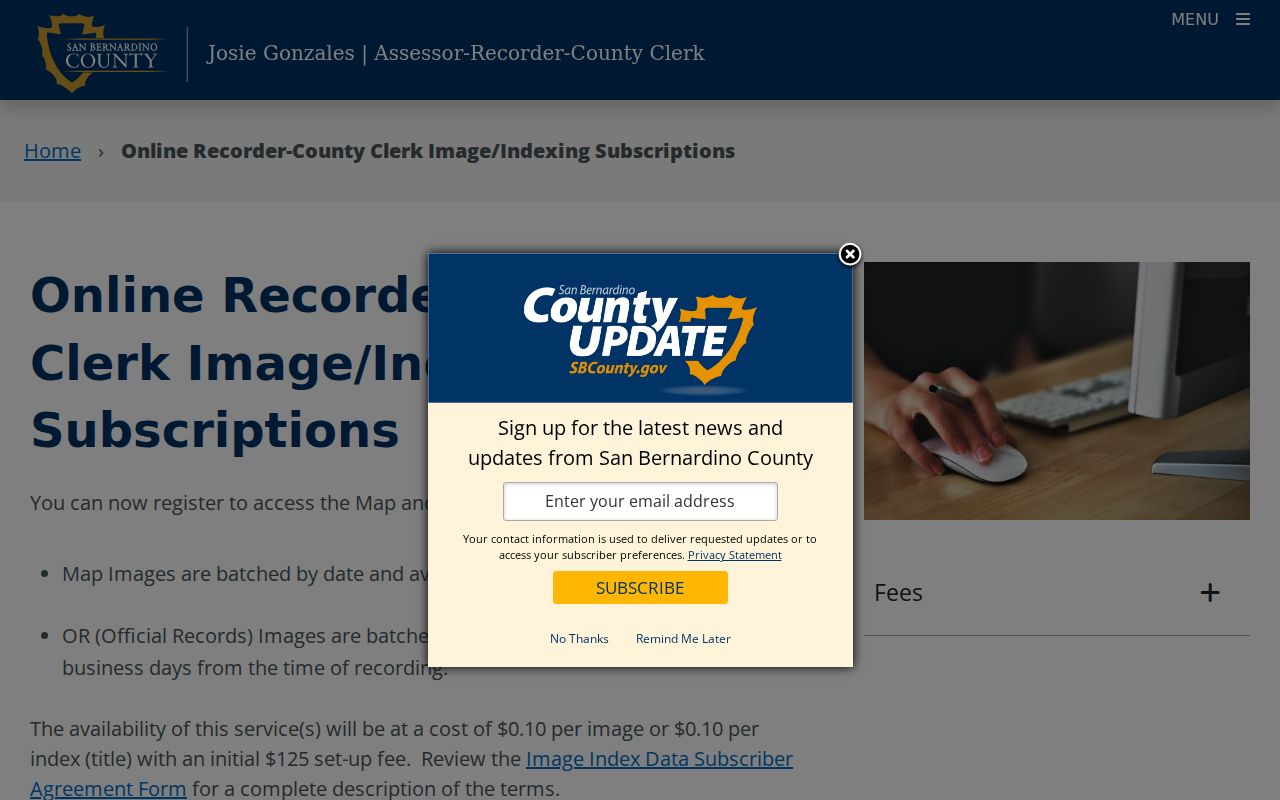
Image access is a separate step after the party index and can supply the legal description needed to keep a past-resident trail aligned.
Chino Previous Residents and Assessment
County assessment valuations are published from 1978 forward. Parcel data can show APN, situs, characteristics, assessed values, exemption indicators, transfer datasets, and map context when public. The assessor warns that assessment information is not a legal title determination. Government Code §7928.205 restricts specified personal owner and address data in electronic or bulk settings.
Assessment history is useful for parcel continuity, not occupancy. A tax account can connect an APN with billed amounts or payment status, but the County Tax Collector warns that payment does not prove who lives there. The tax collector search can begin with mailing address, APN, or an unsecured property number. Return to the recorder for the stronger ownership record.
Keep assessment year, APN, value, and transfer context in separate columns. A later APN may not be the same key used in an older subdivision or deed.
The tax-search image below comes from the San Bernardino County Tax Collector search.
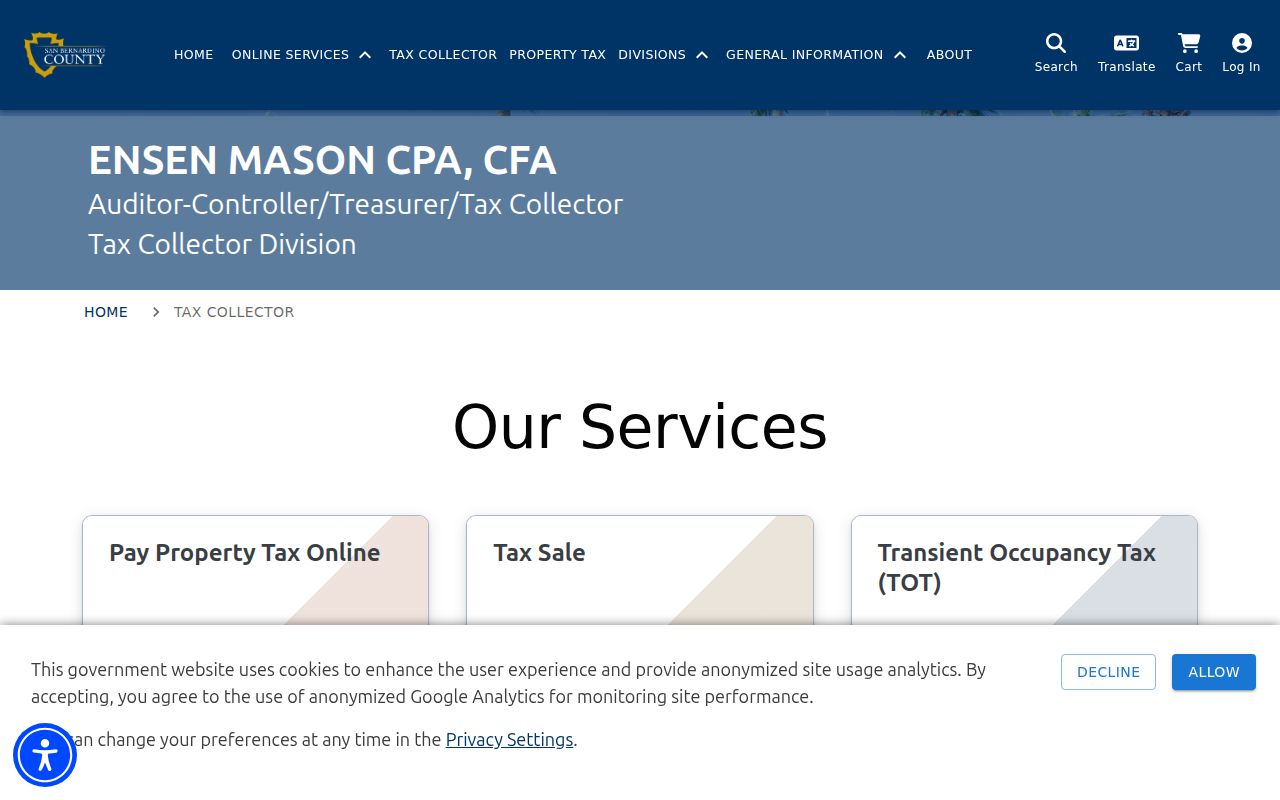
A tax account can help locate a parcel trail, but it cannot turn a payment record into a resident claim.
Chino Sanborn Maps for Past Addresses
The four-sheet Chino Sanborn map from February 1895 is a strong house-history bridge because it fixes a street, footprint, and use at a known moment. It does not name residents. The Library of Congress gallery is the directly verified online source. Later Chino keys cited by federal documentation include 1897, 1907, 1912, 1925, and 1932, but their availability should be checked with a library or archive.
Compare the map with a directory line, census address, deed legal description, and present parcel geometry. If a street number or building footprint changes, mark the continuity as unproven. Agricultural acreage may use a metes-and-bounds or tract description, while later planned communities may use a modern subdivision.
A map can explain why a historical address looks unlike a current one. It cannot fill an absent name.
Chino Previous Residents in Census Years
Public census schedules from 1900 through 1950 can supply household names, ages, relationships, birthplace, occupation, and sometimes address context. Use the National Archives census route or a participating library database. The 1890 census gap is largely national, so the interval between 1880 and 1900 needs directories, deeds, newspapers, church registers, cemetery records, or probate.
A directory may list selected adults while a census enumerates a household at a particular date. Publication lag, spelling, initials, and street abbreviations can make the two records look different. Preserve the exact source line and compare the whole household before deciding that a name moved.
Pairing one directory year with the nearest census year is a process, not a shortcut. The Chino city directory collections page supplies verified regional years and the marks used in the scanned entries.
Chino Address Permits and Move Dates
Chino Accela and Development Services records can show a project address, permit type, applicant, contractor, dates, status, and inspections when the module makes those fields public. A permit can date an addition, remodel, or new construction. It does not date a person's move and does not make the applicant a resident.
Use Chino Accela first. If an older permit or plan is not visible, use the city's NextRequest CPRA route with the address, APN, date range, department, and existing record requested. The city reports that permit copies can be obtained after a public-record request. Plans may be viewed in person, while online access can differ for owners, contractors, and designers.
A permit timeline belongs beside the deed and directory timeline. It can support a structural change while leaving the occupant question open.
Chino Past Residents in Probate Records
When a previous owner disappears from a deed sequence, probate can explain the transfer. San Bernardino CAP probate results may show case type, filing date, parties, hearings, documents, financial information, and the judicial officer. A petition or decree can name heirs or a personal representative. Addresses can be redacted, and sealed or confidential files may not appear.
An obituary adds a different kind of evidence: death, relatives, clubs, last community, or an address in a public notice. Newspapers and local-history indexes can help locate it. The Chino Champion, Ontario local-history resources, and county archives are useful leads. A certified court file or certificate remains stronger than a secondary web notice.
Use probate and obituary material to distinguish a move from a death or inheritance. Do not infer that a relative named in an obituary occupied the house at issue.
Proving Chino Past Address Continuity
A past-resident search can fail when a street number, parcel, or jurisdiction changes. The research did not locate an official citywide street-renumbering chronology. Compare Sanborn sheets, subdivision maps, council records, directory pages, legal descriptions, and present parcel geometry before asserting that an old number is the same house.
Chino's transition from agricultural acreage to modern planned communities makes that check important. Central Avenue, Euclid Avenue, Chino Avenue, Riverside Drive, Schaefer Avenue, Edison Avenue, SR-60, and SR-71 can disambiguate an old notice, but road references alone do not prove parcel continuity. Keep old street number, current street number, APN, tract, lot, block, and map year as separate fields.
The county parcel map is a current bridge. Historic maps and directories are the older bridge. When they do not meet, label the link unconfirmed.
Chino Directories as Household Evidence
Regional city directories supply the household layer that deeds and assessment rolls do not. The verified Chino-bearing runs include selected issues from 1909/10 through 1951, with missing years. A typical entry can show surname, given name or initial, spouse, widow notation, occupation, employer, residence marker, and address. A reverse section, if present, sorts the entry by street and house number. That is why previous residents research needs a dated volume rather than a smooth story.
Read the volume's abbreviation key, record the publication year, and check both alphabetical and reverse pages. A line such as “r Chino” can distinguish a Chino resident from the Pomona core. It still reflects a publisher's selection and may lag a move. A directory is evidence of a listed presence in a publication context, not a complete residents roll.
For current address-keyed records, use the Chino street directory route. For full volume coverage and digital scans, stay with the city-directory shelf.
Chino House-History Privacy Limits
Previous residents research supports family history, preservation, estate work, and neighborhood curiosity. It does not make private household membership public. Renters, relatives, visitors, protected participants, and people absent from a publisher's list may never appear. DMV, utility, and confidential voter data do not supply a lawful substitute.
Safe at Home provides eligible participants a substitute mailing address and confidential voter registration. The program does not erase old records, but it can make a current address a lawful dead end. A public record should never be used to stalk, harass, intimidate, or harm someone.
Note: A dated worksheet with gaps is better house history than a smooth timeline built from untested name matches.